NZ REGISTERED #6605593 NZBN: 9429046511690 ℹ Established Dec 12, 2017 • Parnell, Auckland
Toll-Free: +64 9888 7777 Email: [email protected]
Restaurant Equipment Online Limited
AS/NZS 1668.2:2012 COMPLIANCE

Commercial Kitchen Exhaust Canopy & Airflow Dynamics

Commercial cooking creates significant convective thermal plumes, vaporized grease aerosols, and combustion by-products. Calculating appropriate extraction volume is essential for fire prevention and New Zealand Building Code compliance (Clause G4 Ventilation).

Primary Formula for Island / Wall Canopy Extraction:
Q = V × 2 × (L + W) × H
Where Q is airflow in m³/s, V is capture velocity (typically 0.35 to 0.50 m/s depending on thermal duty), L and W are canopy dimensions, and H is overhang height above cooking appliances.

  • Baffle Filter Velocity: Must maintain 1.0 to 1.5 m/s across filter face area for maximum centrifugal grease drop-out.
  • Make-up Air Balancing: Dedicated tempered supply air must supply 80–85% of exhausted volume to avoid kitchen negative pressure door jamming.
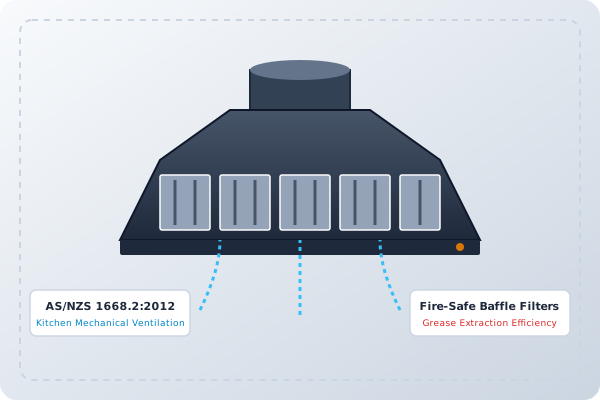
Kitchen Exhaust Canopy Schematic
Commercial Refrigeration Engineering
MEPS & AS/NZS 3823 STANDARD

Commercial Refrigeration: Climate Class 5 & R290 Hydrocarbons

Commercial kitchens regularly experience ambient temperature spikes exceeding 38°C during heavy lunch and dinner rushes. Standard domestic or light-commercial cooling units suffer compressor cavitation and rapid thermal failure under these loads.

Why Climate Class 5 Rating is Mandatory:
Climate Class 5 certifies that refrigeration systems maintain internal holding temperatures between 0°C and +4°C in ambient test chamber conditions of +43°C dry-bulb with 40% relative humidity.

  • R290 Hydrocarbon Transition: Delivers superior thermodynamic latent heat of vaporization with a Global Warming Potential (GWP) of <3 and zero Ozone Depletion Potential (ODP).
  • Automatic Hot-Gas Defrost: Eliminates frost build-up on evaporator coils within 3–5 minutes without internal chamber temperature spiking.
THERMODYNAMICS & ELECTRICAL LOAD

Combi Steamer vs Convection: Heat Transfer & Energy Efficiency

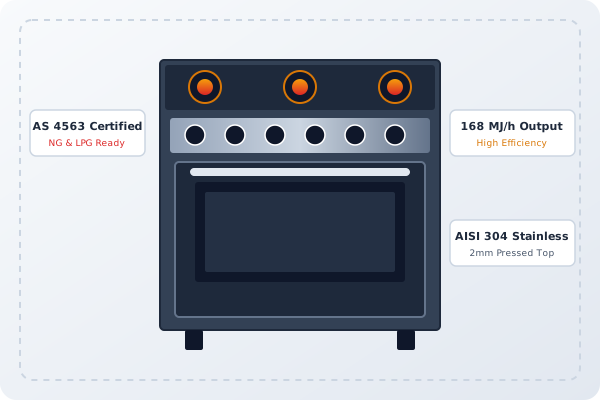
Combination steam-convection ovens represent the core production hub of modern hospitality facilities. By combining dry convective heat with precision saturated steam injection, enthalpy heat transfer rates increase by up to 300% compared to dry air alone.

3-Phase Electrical Balancing Considerations:
A standard 10-tray GN 1/1 combi oven typically draws 18.5 kW across three phases (approx. 27A per phase at 400V 3N~). Sizing main distribution switchboards with appropriate type C circuit breakers and dedicated RCD isolation is critical.

  • Boilerless Direct Injection: Rapid steam generation without standing mineral-scaling boiler reservoirs.
  • Water Filtration Pre-requisites: Total dissolved solids (TDS) must be maintained below 60 ppm with reverse osmosis or demineralizing cartridges to prevent chloride pitting on stainless heating elements.
Cooking Ranges and Combi Ovens
Commercial Pass-Through Dishwasher
AS/NZS 3500 & WATERMARK

Thermal Sanitization vs Chemical Sanitization in Warewashing

High-throughput foodservice operations rely on pass-through hood dishwashers capable of processing 50–65 standard 500×500mm racks per hour (approx. 900 to 1,200 dinner plates).

The 82°C to 85°C Thermal Sanitizing Mandate:
Under the New Zealand Food Act 2014, warewashing sanitization requires either verified chemical contact times or an atmospheric final rinse with water heated above 82°C.

  • Rinse Booster Pumps: Ensure constant 2.0 bar rinse pressure regardless of building mains water fluctuations.
  • Double-Skinned Insulated Hood: Reduces exterior surface heat loss and operator ambient heat exposure by up to 4.5 kW.
METALLURGY & FABRICATION

AISI 304 vs 316 Stainless Steel in Commercial Foodservice Fabrication

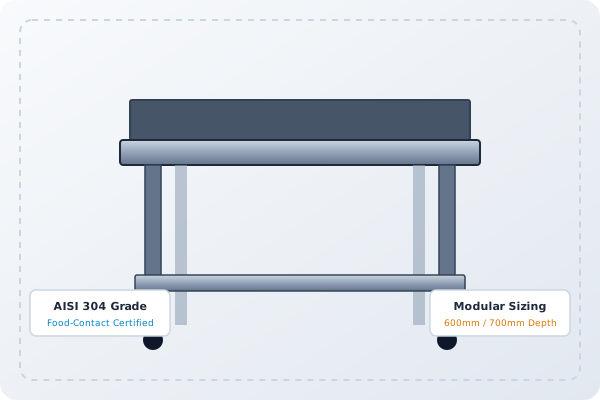
Selecting appropriate stainless steel grades dictates commercial kitchen longevity and resistance to stress corrosion cracking, acidic marinades, and sanitizing detergents.

Stainless Grade Chemical Composition Recommended Application Corrosion Resistance
AISI 304 (18/8) 18% Cr, 8% Ni Prep workbenches, sink bowls, shelving, equipment casings High (Standard Commercial Kitchens)
AISI 316 (Marine) 16% Cr, 10% Ni, 2% Mo Seafood processing, brine tanks, direct coastal hospitality venues Exceptional (Chloride & Salt Resistant)
AISI 430 (Ferritic) 17% Cr, 0% Ni Rear external equipment panels, dry ambient canopy baffles Moderate (Non-wet contact zones)
Stainless Steel Fabrication Standards